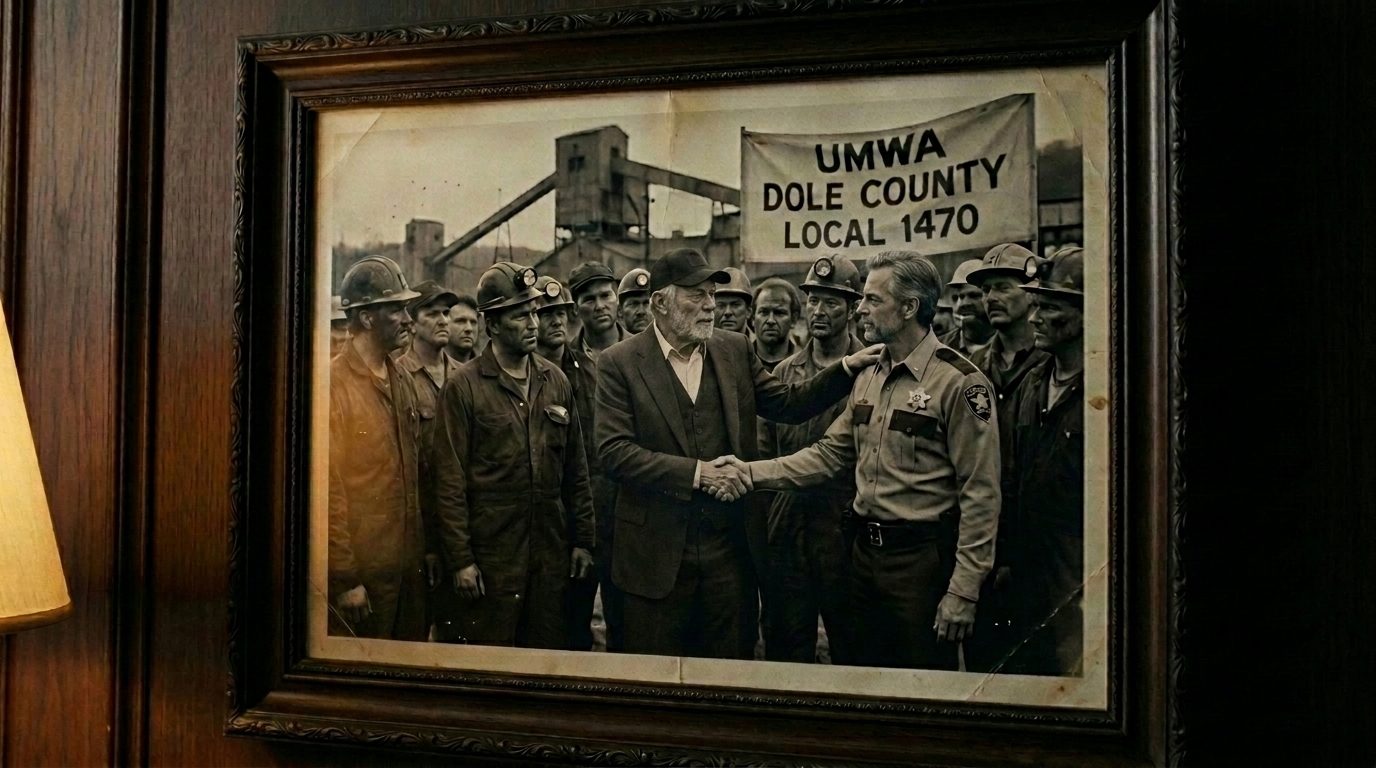
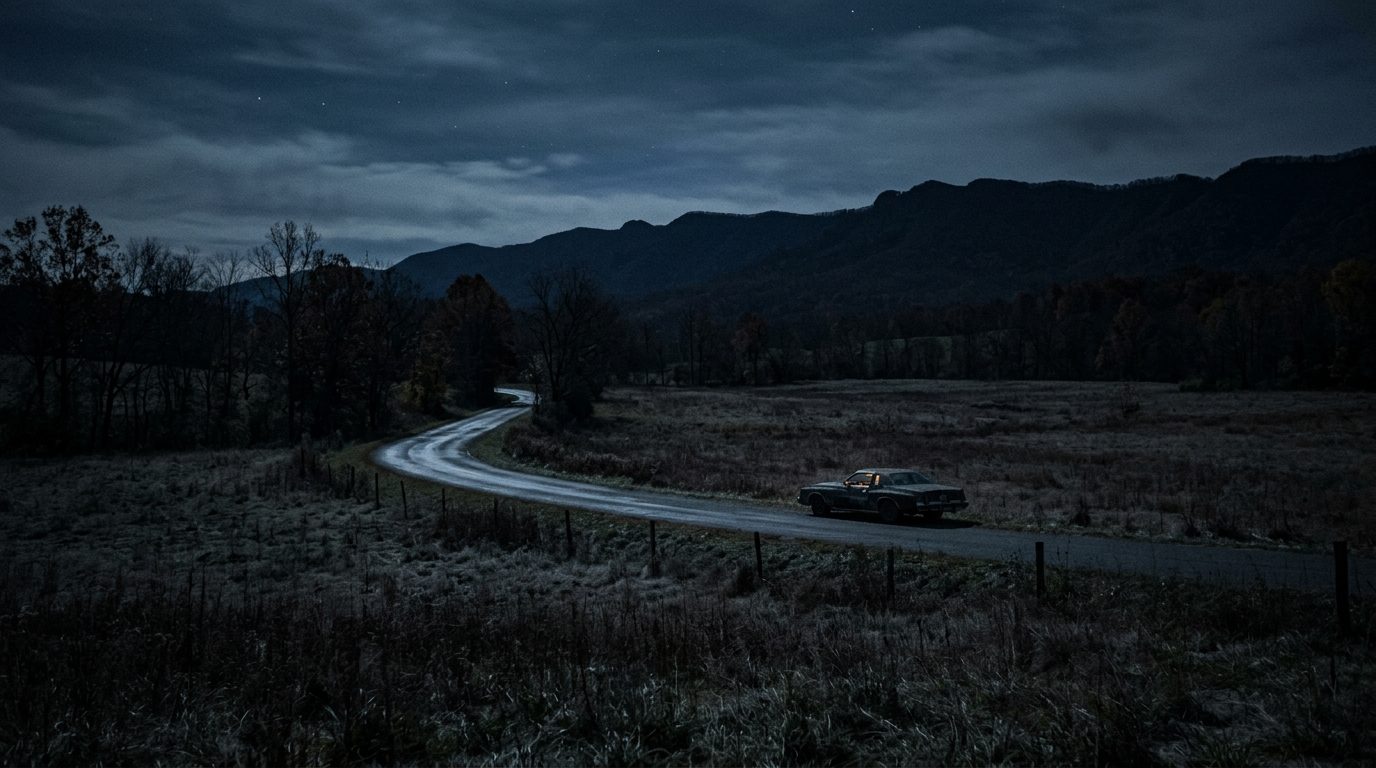
Dole County, Kentucky — 1997
Every man has a name he buried.
Every man has a name he buried.
An ambitious sheriff is drawn into a deadly game of cat and mouse with a mute drifter who knows the one secret that could destroy him — the sheriff's true identity.
A thirteen-episode Southern noir anthology. Appalachian Kentucky, 1997. One county. One stranger. One reckoning.
Autumn, 1997. Having narrowly won a bitter election, the newly elected sheriff of Dole County inherits a community on the verge of collapse. Alliance Coal — the corporation that owns the mountains, the mines, and the men who work beneath them — is preparing a new contract for the local union district. If negotiations fail, a coal miners' strike could cripple the region. Everyone is waiting for the first spark.
Then a mute drifter arrives.
After a high-speed pursuit, he executes a district leader in cold blood. The union is claiming the killing is political. Alliance Coal insists it had nothing to do with it. The community splits between retaliation and denial, each side weaponizing the truth it wants to believe.
As the pressure mounts, all eyes turn to the sheriff — the man elected to keep order, now expected to contain a county sliding toward open conflict. But he carries secrets deeper than the county suspects, and the drifter's arrival begins to pull at a past he thought was long buried.
In Dole County, nothing stays hidden for long — and the line between lawman and everyman is about to collapse.
Slow, lyrical pacing punctuated by sudden, surgical violence. Dust, sweat, hymnals, coal smoke. A score of pedal steel and synth drone. Long takes. Quiet rooms. Then chaos.
Pre-internet Appalachia. A dying coal economy. Picket lines and police lines. Fog on the mountains. Churches with secrets. The kind of place where a man can disappear into a new identity and stay disappeared for sixteen years.
Every episode is built around a moral choice. Dual timelines — 1997 present day and flashbacks tracing Noah's reinvention from 1960s St. Louis to 1980s Kentucky. The past and present converge in the finale.
A cinematic Appalachian world rendered with the visual authority of a Fincher production. Cold air, warm light, fog on the mountains. Every frame designed to make the audience feel the weight of the hills and what's buried beneath them.
A returning anthology in the tradition of True Detective and Fargo — self-contained, novelistic seasons — with the Appalachian texture of Justified and the Southern Gothic dread of Sharp Objects and Mare of Easttown.
Prestige television has rarely visited Appalachia without condescension. Dole County is fictional, but every dialect, hollow, and hymn is drawn from lived experience. It is a part of America that prestige television has rarely taken seriously — and never on this scale.
Alliance Coal's sale to a multinational mid-strike — three thousand jobs gone overnight — mirrors the corporate consolidation gutting working-class America right now. The strike doesn't end in victory or defeat. It ends in being made irrelevant.
Noah Woodford is the show's beating heart and its central moral question. A man elected to uphold the law who undermines it daily to protect himself. He is every leader the country has watched serve the wrong master. Loved by his community. Lethal to it.
The Drifter is mute. What we know of him, we read in his face, his hands, his patience. A villain who is also a victim. A force of vengeance who is also the show's quiet conscience. The role will define the actor who plays it.
Adults 35–65 who consume slow-burn prestige drama. Sundance-leaning, but with broader emotional reach. The same audience that turned True Detective Season 1 into appointment television and Mare of Easttown into the most-discussed show of its summer.
The under-served viewer who built Yellowstone into a phenomenon. The audience that has migrated to streaming but never quite found their show there. Working-class authenticity with prestige craft. Both Americas in the same room.
The Appalachian setting reads globally as exotic and specific. The themes — corporate consolidation, collapsed institutions, identity reckoning — translate across borders. A distinctly American story that says something the world is asking right now.
"I'll take what you love.
Piece by piece."
The slow-burn hunt. The buried mythology. The sense that the investigation is less about catching the killer than excavating the soul of a place. The Drifter and Noah are Cohle and Hart inverted — the hunter and the hunted bound by a shared past neither can name.
The lived-in authenticity of Appalachian speech and silence. The tension between federal law and local justice. Dole County is Harlan with the amp turned up and the irony stripped out.
A family man trapped in a web of his own making, negotiating with every faction to survive. But where the Byrdes adapted, Noah is calcified — sixteen years of performance hardening into a mask he can no longer remove.
Louis Van King is killed on the bridge. The Drifter surrenders. Noah covers it up, poisons the wrong man, and watches the Drifter walk free with a warning: I'll take what you love. Piece by piece.
Churches explode. Randolph Winters's mutilated corpse appears in the mine. Noah hunts the Drifter through the hills — and has his own weapon taken from him. The first flashbacks to 1981 begin peeling Noah's origin story apart.
The picket line erupts. Noah attacks Judge Minton publicly. The Drifter murders Oney's mother. Burkhart punches Noah and walks away. Caroline kisses Loretta. Every institution Noah built his life on begins to crack.
The National Guard arrives. Jerry fires a hunting rifle at a school bus. Tyler records Noah's confession. The Governor replaces Noah with Tyler. Noah drives to St. Louis and executes Ghassan — the last thread to his past.
The Drifter is revealed as Louis Litif — an FBI informant whose family Noah executed in 1980. He attacks the cabin where Trina is hiding. Trina dies. In the finale, Noah kills the Drifter in an abandoned mine, executes Tyler and Oney, stages a shootout, and burns the evidence. He is the last man standing. Weeks later, Caroline uncovers Noah's true identity — Thani Amin — and vows to expose him. Noah prays. God refuses to answer. He walks to the bedroom with an internet cord twisted around his hands. The door shuts behind him.
The Devils of Dole County is conceived as an anthology — but unlike most anthology dramas, every season returns to the same place. Same hills. Same hollers. Same churches and union halls. Different decade. Different reckoning.
Each season excavates Dole County at a different point in its history. The same family names recur. The same mountain looms over every story. Buildings, bloodlines, and grievances that span generations. A character introduced as a child in one decade becomes the antagonist of another. The weight of the past is built into the structure of the show itself.
Future seasons will visit Dole County in earlier and later eras — the labour wars, the boom years, the hollowing out, the present day. Same DNA. Same patient unravelling. Same understanding that every American place has a name buried somewhere — and somebody who's been waiting a long time to dig it up.
Autumn 1997. Union leader Louis Van King is hunting with his thirteen-year-old son Jessie when a 1978 Cordoba forces them off the road. The driver — gaunt, mute, ragged — provokes Louis into a confrontation. Louis draws a silver revolver. The firing pin clicks empty. The Drifter shoots him through the chest. Jessie flees in the truck. The Drifter plants the firing pin back into Louis's gun, lathers his hands in the dead man's blood, and sits down to wait. The arrest is the plan. Sheriff Noah Woodford arrives at the bridge, watches the Drifter on a surveillance monitor — and recognises a ghost from his past. The man in the cell knows his real name. Noah claims jurisdiction, contaminates the Cordoba evidence with bare hands, and finds a blue eye totem hanging from the rearview. He has a panic attack in the bathroom. Late that night, alone in the cell block, Noah drops his mountain-talk façade entirely — speaking for the first time in his real voice — and asks the all-important question: 'How did you find me?' The Drifter scrawls his answer on a notepad: TO SEE WHAT YOU'LL DO.
Weeks before the murder. Noah and Louis share moonshine on a porch — families inside, kids with dogs. But Louis presses: he knows Noah has been taking meetings with Alliance Coal. He wants to know which one he is. The lion or the lamb. In the present, Noah retrieves a hidden duffel from a junkyard cargo container — cash, fake IDs, a syringe filled with poison. He places the poisoned bottle on the Drifter's cell bars. The wrong man drinks it. The Drifter watches with a smile.
Two months earlier. Noah is sworn in as Sheriff before a hall of cheering union miners — and the next morning, his deputies quit one by one, laying their badges on his desk without a word. In the present, the Drifter has vanished into the mountains. Burkhart's manhunt pushes to the rattlesnake-bone border of Luttrell country. Mary K is put on trial by the Union's elders. And the Drifter walks back into Dan Caddy's pawn shop, buries a hatchet in the gun dealer, and pulls a ledger that names the man who bought Noah his rifle.
1982. A Dole County courtroom. Caroline, freshly passed the bar, defends a young gay man under Kentucky's anti-sodomy laws. The judge throws the book — $500 and six months. Outside, a bailiff named Noah approaches her. She already knows him: 'the outsider' — a man who came to Dole County instead of leaving it. He asks her to dinner. She hands him her card. In the present, Caroline pushes a reluctant Noah onto television to fight Holbrook's media campaign. The Reigns family hosts the Woodfords for supper — and in the basement den, Noah catches Tyler hiding a mason jar of Luttrell moonshine inside a wall vent. At a downtown restaurant, Caroline and Loretta nearly kiss across the table. They flee to Caroline's car where their hands touch — until Chief Burkhart's cruiser arrives and shines a floodlight through the window. That night, the Drifter breaks into Randolph Winters's mountain homestead with an ice cream scoop. The next morning, miners halt on the moonscape: Randolph's corpse hangs from the teeth of a continuous mining machine, eyes gouged out, replaced with lumps of coal. On his head, a blue union hat — GOD BLESS THE N.M.W.
1981. Chief Burkhart can't raise his officers on the radio — they're hunting fugitives in the hills. He turns to his janitor and deputises Noah on the spot. They drive to a cabin where a shotgun blast catches Burkhart's vest. Noah grabs the gun from the glove box, kicks down the door, and gives chase through the woods. He drops the male fugitive with a single perfect leg shot from a kneel — and uses the man's shirt as a tourniquet. Burkhart catches up, stunned. Where did a janitor learn to shoot like that? Both men laugh. A bond is forged. In the present, E.P. Pennington calls a strike. At midnight, every miner in District 31 lays down his tools. Noah convinces Nathan Luttrell that there's a rat in his crew — and gets invited to the Luttrell holler workshop where they've supposedly captured the Drifter. It's a trap. The Luttrells pin Noah over an anvil and Nathan brings a Bowie knife to his throat. A diesel generator explodes. The lights go out. A sniper round rips through George Luttrell's chest. The Drifter has come for everyone. Noah breaks free in the chaos, retrieves his own M4 from his Escort, and sprints to the opposing ridge to engage. He fires. He hits the Drifter. He gives chase through the woods. The Drifter pulls a flash-bang grenade from his pant leg with his teeth and lobs it at Noah's feet. White light. Deafening bang. The Drifter picks up Noah's weapon and walks away. He could have ended it. The fun has just started.
1981. A wood-grain station wagon pulls over in Ambrose. A shaggy-haired hitchhiker climbs out with a small suitcase. The chef at the gas station diner serves him murky boiled water — there's an outage. Noah asks directions to Grey Mountain. A pilgrimage, he says. He hikes to the summit and feels a cool wind wash over his face for the first time in years. He's home. In the present, George Luttrell is dead from the Drifter's flash-bang booby trap and a furious Nathan blames Noah for setting them up. Loretta calls the Jasper, Florida police chief — who has never heard of a Albert Ainsley. The forged identity collapses. She knows Noah lied. Caroline attends a black-tie reception at the Governor's Mansion and is humiliated by powerful women whispering she came 'dressed in rags.' She finds Trina kissing a boy in the garden and storms out. State Police Captain Bean offers Noah a KSA position — Noah refuses, citing a tyrannical boss in his past. Most devastating: Nathan Luttrell and four of his men arrive at the Peters trailer and torture Agnus Peters to death because her son betrayed them. The episode ends on the picket line as yellow school buses arrive carrying scabs. Mary K screams into her bullhorn: 'Lay them on a skillet! Fry 'em up!' Police swing clubs. An eye is ripped from a skull. Total bedlam.
1981. Ohio. Noah works farmland for Kaitlynn Gardner, a kind widow keeping her dead husband's land alive. Over lunch she tells him everyone is searching for 'a worthy grave' — an expression from Dole County, Kentucky, where she's from. The more we were loved, the more worthy the grave. She talks about the mountain customs, Grey Mountain, and how character matters more than past in Dole. The next morning, Noah leaves a note: THANK YOU FOR SAVING MY LIFE. ENJOY YOUR NEW RIDE. I'M OFF IN SEARCH OF A WORTHY GRAVE. He hangs the keys to her dead husband's Cordoba and boards a Greyhound bus headed for Lexington. In the present, Loretta and Holbrook bring Judge Minton the proof that Noah's 'Albert Ainsley' file is a fabrication. The Jasper, Florida police have never heard of him. Worse: the day after Burkhart called the plates on the Cordoba, Kaitlynn Gardner's home burned to the ground. Noah told Caroline he was going to step down. Then, at the press conference, he flips the script entirely — accusing his predecessor Gunsmoke of fraud and Judge Minton of covering it up. Caroline is left stunned behind him. The man she married just declared war on the only judge in the county. Tyler is sent into the protest camp that night with rookies. Holbrook's officers attack the encampment with tear gas and clubs. The miners are crushed. Tyler watches a teenage rookie's nose get smashed in. He carries him out.
1981. Portsmouth, Ohio. Noah waits in the Laborers' Local 83 union hall — scrawny, pale, a three-year employment gap on his application. A flashy union steward arrives in a Cadillac Seville. Noah spots the corruption immediately and offers to do the dirty work. The steward refuses. Furious, Noah hurls a cinderblock through the Seville's back windshield and drives off. In the present, Burkhart's officers comb the wreckage of the Drifter's cabin. They drag a submerged car from the lake. They tag and bag the bodies. Most importantly: they recover the severed thumb. Noah arrives with his deputies, ready to lead the manhunt. Burkhart stares him down — he knows now about the doctored files, the Alliance Coal payments, the lies. He cocks his fist and punches Noah across the face: 'You've betrayed the miners. You've betrayed the voters. And you've betrayed me.' Brown uniforms clash with blue in a vicious dog-pile. Burkhart claims jurisdiction and orders Noah off his crime scene. Their sixteen-year bond shatters. That night, a trembling Caroline appears at Loretta's motel room. The two women stare at one another. The intensity builds. Caroline lunges and kisses her. Loretta pulls her inside. The door slams shut.
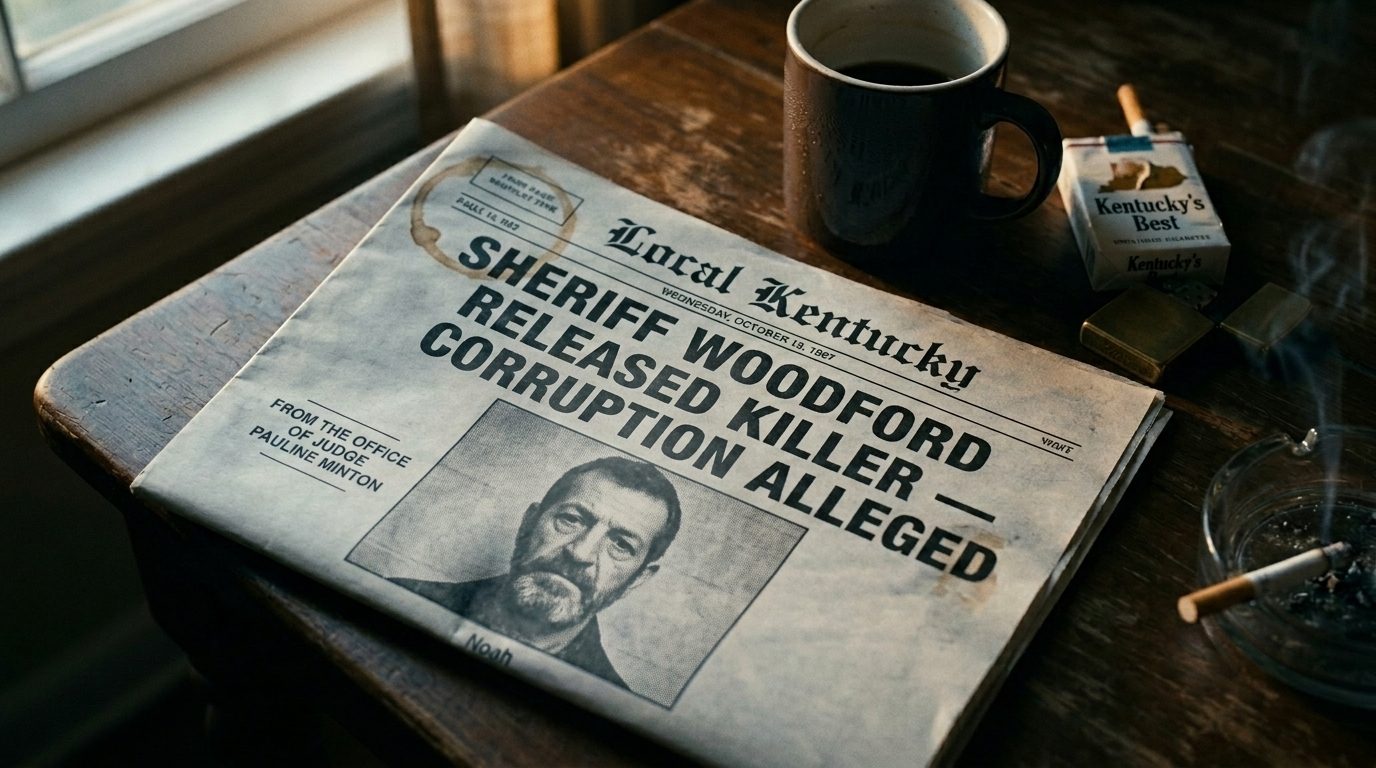
1980. An Ohio emergency shelter. Noah wakes among bunk beds, half-healed bruises on his face. In an AA meeting, the chairperson asks him to speak. He says he's two weeks sober, his car was impounded, and he wants to leave Ohio. When asked what he'd do for work, he says he wishes he could be a cop — like the one he remembers from his youth. He laughs at the idea: the day they pin a badge on his chest is the day hell freezes over. In the present, the morning paper breaks the news: COUNTY SHERIFF FORGES PAPERWORK TO CLEAR UNION MURDERER. Noah doubles down — tripling the reward for 'Albert Ainsley' dead or alive and weaponising the entire population. Caroline confronts him. The Drifter, bleeding out from a wooden shard in his ribs, kidnaps Dr. Myriam from her clinic for emergency surgery. Late that night, Noah's office phone rings. Silence on the other end. Then beeps in rhythm. Noah transcribes the Morse code: T-H-A-N-I. The Drifter knows his real name. The Drifter taps another message: ARE YOU READY TO CALL IT QUITS? Noah smiles. 'I'm just getting started.' The next morning, the storm clears. Dozens of pickup trucks roar toward Dole County — the Wolf County Contingent, shotguns pumped, here for war.
1980. Two weeks before the shelter. Noah — high on cocaine, strung out, enraged — stares at himself in a motel mirror with hatred. He drinks Woodford Whiskey and mocks his own name. He picks fights with bikers and leaves them bloodied. This is Noah at his absolute lowest. In the present, the Wolf County Contingent enacts brutal vengeance — tracking down every scab who crossed the picket line and breaking their hands and kneecaps. Caleb confronts his cousin Jerry, who took scab money to pay for his son's surgery. Caleb beats Jerry with a heavy bike chain in an empty parking lot. Two hundred miners are arrested without a single shot fired. That night, Noah crashes at Tyler's house. In the den, Tyler asks Noah point-blank what really happened to a man named Billy Ray. Noah opens up: 'There's nothing wrong with playing both sides.' Tyler nods, leaves the room, and clicks off the running tape recorder in his pocket. Alone, Noah finds Tyler's hidden moonshine in the wall vent and drinks two glasses straight. The next morning, a battered Jerry sits on his porch swigging the same moonshine. A school bus turns the corner. Caleb's words echo in his head — 'You attack buses.' He grabs his hunting rifle. In the back row, Jessica Siler plays rock-paper-scissors with her best friend. Jerry squeezes the trigger. Cut to black.
1980. A tattoo shop called Stern's. Past a beaded curtain, down a stairwell, a forger called the Bookkeeper scrutinises Noah's new identity through loupe glasses. 'Noah? Really?' The Bookkeeper says it's Hebrew for rest. The documents aren't sophisticated — they're real. Birth certificate. Social security number. Driver's license. A man brought back from the dead. In the present, four professional contractors arrive in Dole County in a black Suburban with St. Louis plates. They check into Loretta's old motel room, build automatic rifles on the bed, and drive toward the Woodford homestead. But Noah is waiting. He picks them off one by one with a high-powered rifle from the treeline, drives the wreck back to his junkyard cargo container, and finds a Local 110 St. Louis union card in one of their wallets. He drives east through the night. He finds the old Stern's tattoo shop converted into a Starbucks. He drives on. At Laborers' Local 42 in the Gate District, he kicks open a side door with guns blazing. He kills three guards and an enforcer named Khalid. He sits down across from Ghassan Souror, the mob figure from his past. Ghassan calls him 'Thani.' He begs for his life. He asks to finish his cigarette. 'A Kentucky sheriff,' he mutters. 'How the fuck does that happen?' Bang.
1980. Warm sunlight in a St. Louis apartment. A man lies in bed — clean-cut, dark hair, familiar brown eyes. Until now, we've only known him as the Drifter. His real name is Louis Litif — a bookkeeper at Local 110, a Lebanese refugee with a wife named Anna and dreams of a quiet American life. His friend arrives for breakfast: a young man named Thani Amin. Louis trusts him. Thani is a Souror enforcer. We watch their friendship across the episode. Italian gunmen for the rival Gallucci family corner Louis and Anna outside their apartment. Louis goes to Thani for protection. Thani delivers Louis's severed tongue to Ghassan Souror, then murders Anna and two FBI agents who were turning Louis into an informant. Louis survives in a hospital bed. He escapes. Thirty years of hunting begin in that hospital corridor. In the present, the Drifter shaves his head, dons a dead man's clothes, and practises speaking for the first time in years. 'Hi. Hi.' The L's won't come. 'Pike. Pike.' Good enough. He drives to the Reigns family cabin where Caroline and Trina are hiding. He rakes the cabin with M16 fire. He bursts through the door, pins Caroline down, and screams 'WHERE. IS. HE.' Trina grabs a curved breaking knife and charges. She stabs his shoulder. He turns the rifle. BANG. Trina dies. The Drifter stands over her body and aims the rifle at Caroline's head.
The late 1960s. A butcher's shop basement in St. Louis. Paul Souror stands over two fourteen-year-old thieves caught lifting beef. He recognises the quiet one as Thani, the butcher's boy. Paul hands his friend a switchblade and orders him to kill Thani. The boy can't do it. Paul hands the blade to Thani. Thani also falters — until Paul motions to his enforcer to make it quick. Cornered, Thani snaps. He stabs his friend repeatedly. He drives the knife into the boy's heart. Pleased, Paul wipes the blade and offers Thani a job. The pearl of wisdom that defines the next thirty years: 'It's the last man standing who tells the tale.' In the present, the Drifter spares Caroline at the cabin and disappears. Trina is dead. Caroline lies in a hospital bed having a nightmare about a faceless Trina in the woods. The county is now under martial law. Mary K is making a final stand against the National Guard with a dozen miners; Caleb leads the others out across county lines. Nathan Luttrell tortures Oney for the Drifter's location. Noah teams up with Nathan and his moonshiners and descends into the abandoned mine shaft. A bloody firefight ensues underground. Nathan kills the Drifter's men. The Drifter kills Nathan's men. Nathan pins the Drifter and drives a Bowie knife into his chest. Noah arrives — and shoots Nathan through the back of the head. The two enemies face each other alone. The Drifter signs his final message: 'I'm sorry about your daughter. I won.' Noah stabs him in the same pressure points he used in the basement thirty years earlier and watches him bleed out smiling. Outside, Tyler intercepts Noah dragging the bodies. They draw on each other. Noah's Kevlar saves him. Tyler's shirt blooms red. Noah executes Tyler at point-blank range. He shoots Oney too. He stages a shootout between the corpses. He burns the scene. Weeks later, the snow falls. Caroline pieces it all together — Thani Amin, former Syrian mob soldier, two dead FBI agents, a vanished informant. She confronts Noah at the dinner table with a folder of evidence and vows to expose him. She walks to the bedroom to pack a suitcase. Noah prays. God refuses to answer. He unplugs the internet cord, twists it around his hands, walks down the hallway. The door shuts behind him.
"It's the last man standing
who tells the tale."
— Paul Souror, 1965

The courthouse. The jail. The sheriff's office. Where Caroline prosecutes cases by day and her husband breaks the law by night. The political centre of a county that has stopped trusting its institutions.
Wood-grain station wagons and gas station diners. Where Noah stepped off a hitchhiking ride in 1981 with a duffel bag of someone else's initials. Chief Burkhart's station. Grey Mountain rising above it all.
Where the mines are. Where the strike is. Where George Luttrell runs moonshine out of hollers the state police can't find. The poorest, angriest, most forgotten corner of Dole County — and where the war will begin.
"Everyone in Dole County
is hiding something."
— Dole County, Kentucky
Everyone in Dole County is hiding something.

"How did you find me?"
A pious lawman hiding a lifetime of sins. The man Dole County elected is not who they think he is. Revered by his community, haunted by a past that's about to catch up with him.

"To see what you'll do."
Methodical. Relentless. Here to dismantle Noah's carefully constructed life, one thread at a time. His real name is Louis Litif. He hasn't spoken in years.

"Who did I marry?"
Noah's wife. Career-driven, sharp, and harbouring secrets of her own. Romantically entangled with an FBI agent. The smartest person in every room — and the most dangerous.

"I liked hurting them."
Hearing-impaired tomboy. The moral compass of the Woodford family. Sees more than anyone suspects. The only innocent left in this story.

"Where did a janitor learn to shoot like that?"
Ambrose Township Police Chief. Noah's closest friend and ally. Rosy cheeks, big belly, bigger heart. The only man who'd take a bullet for the sheriff.

"I think we got him."
Investigating church bombings. Romantically tied to Caroline. An outside force pulling at the county's threads. She didn't come here for the bombings.

"The line will not move."
Anointed district leader after Louis Van King's assassination. Brutal tactics. Old-school union muscle in a world that's moved on without him.

"Lay them on a skillet. Fry 'em up."
Fierce, hungry, and ready to burn it all down for the workers. A new generation fighting with yesterday's weapons. She wants E.P.'s seat — and she'll take it.

"Sell what we can. Burn the rest."
The coal baron. Will crush the strike at any cost. The corporate devil to the county's personal ones. Owns the mountain and everyone on it.
The Drifter and Noah are two strands of the same twine, bound by a shared origin they each refuse to fully confront. The Drifter devotes himself entirely to unearthing Noah's buried past, turning that fixation into a driving force that pushes him toward increasingly extreme acts, including murder. Noah, in turn, is consumed by the maintenance of a constructed identity — willing to sacrifice nearly anything, and anyone, to preserve the illusion he presents to those closest to him.
This fabricated identity forces Noah into a constant double life. He is plagued by impostor syndrome, relying on faith and medication to steady himself against the weight of it. The Drifter mirrors him in distorted reflection, attempting to inhabit Noah's perceived moral authority while numbing his own fracture through substance abuse. Both men remain trapped by the same unresolved event, unable to move beyond it, each reinforcing the other's collapse.
This obsession with identity extends beyond them. Caroline, born into poverty, has spent her life relentlessly climbing toward social legitimacy, treating advancement as discipline rather than desire. Her worldview renders even intimacy transactional, including her own. Only when she is shut out of the elite spaces she has pursued does she begin to reassess herself, confronting the class origins she has long suppressed and beginning, for the first time, to reassemble a more truthful sense of self.
Despite his past defining his new life, Noah dissociates from his history at every turn. The Drifter ruminates in it, refusing to let go of everything he's lost. This tension — between forgetting and remembering — is the engine of the series.
We see this rumination across Dole County. E.P. and Mary K play by the old rules of a union strike while capitalism crushes them beneath its boot. Conversations romanticise old traditions and folklore while technology and advancement are despised. These hill people cling to the past while their future slips away.
They have become so disillusioned by their prospects that they willingly elect an official who constantly undermines the rule of law to serve his own interests. Institutions erode. Public trust collapses. Neighbours turn against neighbours. A once compassionate community implodes.
Three voices. One vision.
Matt Daniels is the creator, writer, and showrunner of The Devils of Dole County. He is also the writer of IMOLA, the true-story Formula 1 drama currently out to Ridley Scott. Episodes 101 and 102 of DODC are complete; the remaining episodes are in active development.
[Bio to be added — Lee to provide: previous credits, what brought DODC to the table, vision for the show.]
[Bio to be added: RBR credits, background, relationships with talent and platforms.]
Establishing the visual language of the series.
Sanders is attached to direct the pilot and establish the visual language of The Devils of Dole County — an Appalachian Gothic register built on his signature gift for painterly composition, atmospheric world-building, and the prestige cinematic grammar he has brought to features for over a decade.
His attachment sets the tone for the series.
The Devils of Dole County — Season One
The murder is a puzzle box. The killer is a ghost. The sheriff is a lie.
While returning from a hunting trip, union leader Louis Van King and his thirteen-year-old son Jessie are hounded by a 1978 Cordoba. Forced onto the roadside, Louis confronts a gaunt, mute drifter and escalates the encounter into violence. He draws his handgun, but the firing pin clicks empty. The Drifter shoots him through the chest. Jessie is allowed to flee. The arrest was always the plan.
At the station, Sheriff Noah Woodford recognizes a ghost from his past. He claims jurisdiction, contaminates evidence, and suffers a panic attack in the bathroom. The murder is reverse-engineered architecture — the killer wanted to be caught. The man Dole County elected has spent sixteen years perfecting a role. The man in the cell is the only person on earth who knows it isn't real.
Later that night, alone in the cell block, Noah drops his mountain-talk façade entirely, speaking for the first time in his real voice. "How did you find me?"

"The killer sits in a cell downtown. He wanted to be caught."

"He was already sitting in the blood."

"Sixteen years perfecting a role."

"Who did I marry?"
HE SAT IN THE BLOOD
FOR FORTY-SEVEN MINUTES.
HE JUST WAITED.
Noah tries to kill the Drifter. The wrong man dies. And then the Drifter speaks.
The teaser rewinds to a warmer world — Noah and Louis Van King on the porch, cigars and moonshine, the easy intimacy of men who owe each other debts. But Louis has questions Noah can't answer. A Revolutionary War musket changes hands. A friendship begins to crack.
In the present, Noah is being squeezed from every direction. The union wants the Drifter handed over for hill justice. Alliance Coal wants charges by morning. Judge Minton has found sixty-three thousand dollars missing from the sheriff's fund. And in his cell, the Drifter plays chess against himself with hand-drawn pieces — patient, methodical, waiting. He mailed a letter to Holbrook before the murder. He planned to end up in custody. Every move is architecture.
Noah poisons a bottle and places it on the cell bars. The Drifter ignores it. A belligerent moonshiner grabs it instead and dies foaming on the concrete. Noah covers it up, forges a false identity, runs a decoy convoy across the county, and drives the Drifter to freedom — intending to kill him at a pre-dug grave. But at the impound lot, the Drifter communicates for the first time — in perfect ASL. There are no copies of the photographs. He just wanted to see what Noah would do. And Noah chose to lie, forge, poison, and conspire. The Drifter's final message: what Noah loves is what he'll take. Piece by piece.
Backed into a corner, Noah constructs a false identity — Albert Ainsley — to reframe Louis's killing as self-defense and neutralize the mounting pressure. After a high-stakes pursuit across the region, he releases the Drifter in an attempt to contain an increasingly unmanageable situation. But the Drifter rejects closure, revealing the conflict is not ending — only beginning.

"The Drifter speaks for the first time — in flawless sign language. There were never any copies. He only wanted to see what Noah would do."

"Somewhere in the county, a stranger sets up shop."

"Three pillars of Dole County. None of them aligned."

"The new sheriff arrives. The badges start to fall."
THE MAN THEY ELECTED
TO KEEP THE PEACE
WAS THE ONE WHO
STARTED THE WAR.
The day Noah was sworn in, half his deputies quit. Now the man he set free has vanished into the mountains — and everyone is hunting him at once.
The cold open rewinds two months. Noah takes the stage in his Class A uniform and is sworn in as Sheriff before a hall packed with union miners. He thanks his family, credits the Union, praises God, and promises the county that no lawman of his will ever again be owned by a coal baron. Louis Van King leads the applause. Then, on Noah's first morning behind the desk, the betrayal answers back: one by one, his deputies walk in out of uniform, lay their badges on his desk, and leave without a word. He can only watch the pile grow.
In the present, the manhunt for the Drifter — Leo Ainsley — is already collapsing. Tyler tails the burning Cordoba, Noah sabotages his own pursuit, and the car is found a charred skeleton with no body inside. Chief Burkhart's K-9 units push the search up Grey Mountain until they reach a tree line strung with hundreds of rattlesnake skeletons — the border of Luttrell country, where the law no longer holds sway. At the Union Hall, Mary K is put on trial by the nine elders of the Executive Board. They want a settlement; she wants blood. They pass her over for the presidency, and one of them leaves her with a warning: when you set out with rattlesnakes, you answer for everyone they bite.
The pressure finds everyone. Trina, bullied and stripped of her hearing implant, drives a pencil through the boy's hand in a silent classroom. Caroline, shamed by an old woman from her own holler, takes on the defence of the man who once aimed a shotgun at her husband. And Noah, hunted in his own yard, cuts the deal that will damn him — Thunder Road for the Luttrell Brothers, once they deliver Ainsley. But the Drifter is already a step ahead. He walks back into Dan Caddy's pawn shop, buries a hatchet in the gun dealer, raids the hidden weapons depot beneath the floor, and pulls a ledger that names the man who bought Noah his Moravian rifle. He loads two duffel bags into a stolen van. The war is no longer Noah against a ghost. The ghost is coming with a paper trail.

"A tree line strung with hundreds of rattlesnake skeletons, fangs bared. Past it, the Sheriff's writ means nothing."

"He clears his desk while his Chief watches. The biggest mistake of his career, they tell him."

"One by one, the deputies lay down their badges. He can only watch the pile grow."

"She wanted blood. The elders wanted a settlement. They chose the settlement."
WHEN YOU SET OUT
WITH RATTLESNAKES,
YOU ANSWER FOR
EVERYONE THEY BITE.
A courtroom in 1982. A young attorney. A young bailiff. A love story built on a foundation that doesn't exist.
1982. A Dole County courtroom. Caroline — freshly passed the bar, terrified but refusing to show it — defends a young gay man wrongly arrested for solicitation under Kentucky's anti-sodomy laws. The cantankerous old judge sentences him anyway. Outside, a young bailiff approaches. Caroline already knows him: 'the outsider' — a man who came to Dole County instead of leaving it. Noah asks her to dinner. She tests him on her client. He says he saw plenty of gay folk in Atlanta and it never bothered him: 'Kentucky will catch up.' She hands him her card and walks away. He's grinning ear to ear.
In the present, the church bombings draw national press. Randolph Winters demands Noah get E.P. back to the negotiating table at any cost — even framing the bombings on a single 'lone, crazed miner.' Caroline pushes a reluctant Noah onto television to fight Holbrook's media campaign. The Reigns family invite the Woodfords for supper. In Tyler's basement den, Noah watches his sergeant pour Luttrell moonshine and hide the mason jar inside a wall vent — Tyler's secret place where his wife Ashley wouldn't find it. Noah doesn't drink. He just files the location away.
At a downtown restaurant, Caroline and Loretta nearly kiss across the table. Caroline panics and flees to her car. Loretta follows. Their hands touch on the gearshift — until Burkhart's police cruiser pulls up beside them and shines a floodlight through the window. The two women freeze. That night, the Drifter breaks into Randolph's mountain homestead. He pours himself a whiskey, browses the bookshelf, and walks into the kitchen searching for the perfect weapon. He picks up an ice cream scoop and smiles. The next morning, miners on the moonscape stop in horror. Randolph's corpse hangs from the teeth of the continuous mining machine — eyes gouged out and replaced with lumps of coal, a blue union hat on his head: GOD BLESS THE N.M.W.

"She's just passed the bar. He's the outsider who came to Dole County instead of leaving it. She hands him her card. He's grinning ear to ear."

"The old lion can't breathe. The new sheriff steadies him."

"Eyes of coal. A blue union hat. GOD BLESS THE N.M.W."

"A friend of the family. The first secret she ever kept from him."
SHE FELL IN LOVE WITH
A MAN WHO DIDN'T EXIST.
HE FELL IN LOVE WITH
THE ONLY WOMAN WHO
COULD DESTROY HIM.
A janitor gets a badge. A night in the hills forges a bond. A loyalty that will be tested to destruction.
The cold open puts a badge on Noah's chest for the first time. 1981. Burkhart's officers are out of radio range hunting fugitives. He looks at his janitor pushing a cart down the hall and makes a decision that will define both their lives. He deputises Noah, hands him a vest, and drives them into the woods. Noah asks if he should be armed. Burkhart glances at the glove compartment. 'It won't be necessary.' At the cabin, a shotgun blasts through the door — buckshot strikes Burkhart's vest. Noah grabs the gun from the glove box, kicks the door open, charges through the back. He drops the male fugitive with a single perfect shot to the leg, then uses the man's shirt as a tourniquet. Burkhart arrives spellbound. Where did a janitor learn to shoot like that?
In the present, the strike begins. E.P. Pennington wheels his oxygen cart to the union hall podium and announces that, starting at midnight, every miner in District 31 lays down their tools. The county erupts in applause. Mary K and Caleb plot retaliation against Chief Holbrook — the old strikebreaker. The Drifter watches from a ridge through binoculars and settles on the same target. Noah convinces Nathan Luttrell that there is a rat in the moonshiner crew. Nathan calls Noah to the holler workshop. They've captured Albert Ainsley.
It's a trap. The Luttrells pin Noah over an anvil. Nathan brings his Bowie knife to Noah's throat. A diesel generator explodes. The lights go out. A high-pitched screech — and a rifle round rips through George Luttrell's chest. The Drifter has come to kill them all. Noah breaks free in the chaos, sprints to his Ford Escort, retrieves his own M4 rifle, and races to the opposing ridge. He spots a muzzle flash through the trees and returns fire. He hits the Drifter. He gives chase through the dense woods, weapon shouldered, closing the distance. He's calling out — promising to make it painless — when the Drifter pulls a flash-bang grenade from his pant leg, pulls the pin with his teeth, and lobs it at Noah's feet. White light. Deafening bang. When Noah's eyes refocus, his weapon is gone and so is the Drifter. He could have ended it. The fun has just started.

"White light. Deafening bang. When his eyes refocus, his weapon is gone — and so is the Drifter. He could have ended it."

"Where did a janitor learn to shoot like that?"

"At midnight, every miner in District 31 lays down their tools."

"A janitor with a steady hand. Burkhart never asks twice."
IN THESE HILLS,
THE OLD STORIES
AREN'T STORIES.
THEY'RE WARNINGS.
A stranger steps off a station wagon. No name. No history. The architecture of a new man begins.
The most important origin scene in the series. 1981. A wood-grain station wagon pulls over on Main Street in Ambrose. A shaggy-haired hitchhiker steps out with a small suitcase. He drinks brownish water at a gas station diner — there's an outage. He asks directions to Grey Mountain. A pilgrimage, he says. He hikes to the summit in crushing heat, looks out across endless Appalachia, and feels a cool wind wash over his face. He smiles for the first time in a long time. He's home. He pays his new landlord a wad of cash and takes the room.
In the present, George Luttrell is dead from the Drifter's flash-bang booby trap. Nathan blames Noah for setting them up — and Noah convinces Nathan there's a rat in their crew. Loretta calls the Jasper, Florida police chief who has never heard of a Albert Ainsley. The forged identity collapses. She takes the file to Holbrook: 'I think we got him.' Caroline attends a black-tie reception at the Governor's Mansion that she's been climbing toward her whole life. The powerful women whisper she came 'dressed in rags' and joke that Dole County is more boorish than Wolf. She finds Trina kissing a boy in the garden and storms out, devastated.
State Police Captain Bean offers Noah a Kentucky Sheriffs' Association position with five deputies tomorrow and ten more if he joins. Noah refuses, citing a tyrannical boss in his past. Most devastating of all: Nathan Luttrell and four of his strongest men arrive at the Peters trailer. They draw the shades. Agnus laughs in Nathan's face — telling him a story about how small his manhood was when his mother paraded him naked as a boy. He draws his Bowie knife. She closes her eyes. The next morning, yellow school buses roll toward the picket line carrying scabs. 'Blacklegs!' Mary K screams into her bullhorn. 'Lay them on a skillet! Fry 'em up!' Bottles fly. Police clubs swing. An eye is ripped from a skull. Total bedlam.

"He has six months left in his lungs. He spends them rallying every miner left in Dole County. The line will not move."

"Through the cracked window — the men who came to take their work."

"They descend together. They will surface together or not at all."

"The strike begins. The line will not move."
HE ARRIVED WITH NOTHING.
HE BUILT EVERYTHING.
AND NONE OF IT
WAS REAL.
A farm in Ohio. A kind widow. A phrase that will haunt a man for sixteen years.
The cold open is the origin of everything that follows. Ohio, 1981. Kaitlynn Gardner — a warm, plain-spoken widow — watches Noah work her dead husband's farmland. Over lunch she tells him about Dole County, Kentucky, where she grew up. She describes the mountain customs, the coal camps. She tells him everyone is searching for 'a worthy grave' — a place where who you were and who you became can finally rest together. Some folks get dumped in a roadside ditch. Others get entombed like pharaohs. The more we were loved, the more worthy the grave. The next morning Noah leaves a note on her refrigerator: THANK YOU FOR SAVING MY LIFE. ENJOY YOUR NEW RIDE. I'M OFF IN SEARCH OF A WORTHY GRAVE. He hangs the keys to her late husband's Cordoba and boards a Greyhound headed for Lexington.
In the present, Loretta and Chief Holbrook bring Judge Minton the proof that Noah's 'Albert Ainsley' file is fabricated — the Jasper, Florida police have never heard of him. Worse: the day after Burkhart called the plates on the Cordoba, Kaitlynn Gardner's farmhouse burned to the ground. They don't know yet whether Noah ordered the arson or the Drifter did it himself. Either way, the man Noah released has burned to ash the only person who knew Noah was the Cordoba's true owner. Caroline is hauled into Minton's chambers. Sixty-three thousand dollars missing from the Sheriff's discretionary fund. Caroline tells Noah he should step down. Heartbroken, he agrees.
That night, Holbrook's officers march into the union protest camp with tear gas and clubs. Tyler is there with the rookies. He freezes. A burnt miner charges him — a rookie steps in front and takes the blow. Tyler carries the boy out as the camp burns to rubble. The next morning, Caroline adjusts Noah's Class A uniform for his resignation press conference. He pats his pockets for his nerve pills and finds Sheriff Bean's KSA card instead. The wheels start turning. He steps to the podium — and rather than step down, he flips the script entirely. He accuses his predecessor Gunsmoke of fraud, the judge of covering it up. He won't capitulate to the corrupt. 'I was elected to do this job and I'm gonna do it. I don't care if it harelips the devil himself.' Caroline is left stunned. The man she married just declared war on the only judge in the county.

"He squeezes the trigger and misses. Then squeezes again. The hand will learn."

"The old leader. The next leader. One winded breath at a time."

"In Dole County, grace is scrubbed in by hand."

"He declares war on the only judge in the county."
EVERYONE IS SEARCHING
FOR A WORTHY GRAVE.
MOST OF US JUST
DON'T KNOW IT YET.
A wrinkled résumé. A three-year gap. Nobody asks. In the present, everybody breaks.
1981. Portsmouth, Ohio. Noah waits in the Laborers' Local 83 union hall — scrawny, pale, three-year employment gap on his résumé. A union steward arrives in a Cadillac Seville and inspects Noah like a stain. Noah spots the corruption immediately and offers to do the dirty work — collect dues, handle muscle. The steward declines. 'We don't go in for that anymore.' Furious, Noah hurls a cinderblock through the Seville's back windshield and tears out of the parking lot. The architecture begins.
In the present, Caroline sits in shock in Judge Minton's office after Noah's surprise press conference attack. The County Commissioners want her to testify against him. Across the county, Burkhart's officers comb the wreckage of the Drifter's cabin from the previous night. They tag and bag the moonshiner bodies. They drag a submerged car from the lake. Most chillingly: they recover a severed thumb from the dirt — the Drifter cut his own to slip his bonds. Burkhart pieces the picture together: doctored files, payments from Alliance Coal, sixteen years of his protégé hiding something. He puts an APB out on Noah.
Noah arrives at the cabin scene with his deputies, ready to take over the manhunt. Burkhart stares him down — he knows. He cocks his fist back and punches Noah across the cheek. Brown uniforms clash with blue in a vicious dog-pile. Burkhart claims jurisdiction and orders Noah off his crime scene. Their sixteen-year bond — forged in those hills with a borrowed badge — shatters. That night, a trembling Caroline appears at Loretta's motel room. She lunges and kisses her. Loretta pulls her inside. The door slams shut.

"He unzips the bag. A bundle of red sticks. A blinking red number. The last face he sees is his own reflection in the glass."

"An APB goes out on the Sheriff of Dole County."

"Cash only. No questions. No paperwork that bears a name."

"Nathan blames Noah. The Luttrells settle debts in person."
THE DRIFTER DIDN'T NEED
TO TEAR THEM APART.
HE JUST HAD TO WAIT.
The Drifter returns. The National Guard is called. The county descends into something approaching war.
1980. An Ohio emergency shelter. Noah wakes among bunk beds with half-healed bruises on his face. He bums a cigarette and slumps into an AA meeting where the chairperson asks him to share. He says he's two weeks sober, his car was impounded, and he wants to leave Ohio. When asked what he'd do for work, he says he wishes he could be a cop — like the one he remembered from his youth, who walked his streets and cared. He laughs at the idea. The day they pin a badge on his chest is the day hell freezes over. The chairperson doesn't know how to respond.
In the present, the morning paper breaks the news: COUNTY SHERIFF FORGES PAPERWORK TO CLEAR UNION MURDERER. Caroline confronts Noah. He doubles down — holding his most audacious press conference yet, tripling the reward for 'Albert Ainsley' dead or alive. The county becomes a hunting ground. Loretta is recalled to the FBI for breach of conduct and packs to leave town. She drives past the Woodford homestead one last time and decides not to say goodbye. The Drifter, bleeding out, kidnaps Dr. Myriam from her clinic and forces her to operate on his shattered hand at gunpoint.
Late that night, the phone rings in Noah's office. Silence on the other end. Then beeps in rhythm. Noah grabs pen and paper and transcribes the Morse code: T-H-A-N-I. The Drifter knows his real name. The Drifter taps another message: ARE YOU READY TO CALL IT QUITS? Noah stares at the receiver. 'I'm just getting started.' The next morning, the storm clears. Dozens of pickup trucks roar toward Dole County — the Wolf County Contingent, grizzled men pumping shotguns. They aren't here for the reward. They're here for war.

"The reward triples overnight. The old ways come down from the hills. Dead or alive means dead."

"She drives past the homestead one last time. She doesn't say goodbye."

"They aren't here for the reward. They're here for war."

"The Guard is coming. The county becomes a stage."
HE CALLED IN THE
NATIONAL GUARD
TO FIND ONE MAN.
IT WAS SELF-PRESERVATION.
Every institution collapses. Caroline reaches the bottom. The hollow men are exposed.
1980. The darkest scene in the series. Noah in a motel bathroom — high on cocaine, staring at himself with rage and self-loathing. A prostitute collects her money and leaves. He sits in a diner at dawn waiting for a bar to open. He drinks Woodford Whiskey and mocks his own name in a fake southern accent. He picks fights with bikers and wins, fast as lightning despite being drunk. This is a man methodically erasing himself. Not in despair — in discipline. Destruction as practice.
In the present, the Wolf County Contingent enacts brutal vengeance. Across the county, every miner who took scab money is hunted down and beaten. Hands smashed. Wrists broken. Kneecaps shattered. None will ever mine again. Caleb Miller corners his own cousin Jerry in an empty parking lot. Jerry begs for mercy — his son needs surgery, he had no choice. Caleb beats him with a heavy bike chain. 'You don't get on those school buses. You attack those school buses.' Two hundred miners are arrested without a single shot fired. Noah crashes at Tyler's house that night. In the den, Tyler asks him point-blank what really happened to Billy Ray. Noah confesses: 'There's nothing wrong with playing both sides.' Tyler nods, leaves the room, and clicks off the running tape recorder in his pocket.
Alone in the den, something breaks loose in Noah. He stares at the wall vent. He kicks off his blanket, twists out the screws, and pulls Tyler's hidden moonshine from its hiding place. He pours a glass and drinks. Then another. Fuck it all. The next morning, a battered Jerry sits on his porch swigging the same moonshine. A school bus turns the corner. Caleb's words echo: you attack buses. He grabs his hunting rifle. In the back row, Jessica Siler plays rock-paper-scissors with her best friend, smiling. Jerry narrows his sights. Squeezes the trigger. Cut to black.

"Whiskey on the tiles. Badge on the floor. The neon outside still asks the only question that matters."

"Not in despair — in discipline. Destruction as practice."

"Tyler nods, leaves the room — and clicks off the tape recorder in his pocket."

"Hollow men, hollow weeks. The badge gets heavier."
THE HOLLOW MEN BUILT
THEIR LIVES ON NOTHING.
NOAH WAS THE MOST
HOLLOW OF THEM ALL.
The church falls. The allies scatter. The forger resurfaces with one word: they know.
1980. A tattoo shop called Stern's. Past a beaded curtain, down a stairwell, a forger called the Bookkeeper scrutinises Noah's new identity through loupe glasses. 'Noah? Really?' The Bookkeeper says it's Hebrew for rest. Most of his customers are ready for a long repose. The documents aren't sophisticated — they're real. Listed in the social security database. A genuine birth certificate. A driver's license. He hands Noah a dense biographical script to memorise. This is the moment the performance begins.
In the present, the Governor wants Noah gone. His replacement is Tyler Reigns, at Judge Minton's recommendation. Caroline tracks down Oney Peters and interrogates him. Oney breaks — confessing the dead drops, the ANFO, every word he fed about the Drifter. Four professional contractors arrive in Dole County in a black Suburban with St. Louis plates. They check into Loretta's old motel room and assemble automatic rifles on the bed. They drive toward the Woodford homestead to kill Noah. But Noah is waiting in the treeline with a high-powered rifle. He picks them off one by one — three through the windshield, one crawling for cover. He drives the wreck back to his junkyard, finds a Local 110 union card in one of their wallets, and drives east through the night.
St. Louis. The old Stern's tattoo shop is now a Starbucks. Noah pulls up at a rec centre — Laborers' Local 42 in the Gate District. He kicks open a side door with guns blazing. Three guards die. An enforcer dies. Noah sits down across from Ghassan Souror — the man who set him up with his new identity thirty years ago. Ghassan calls him 'Thani.' He begs for his life. He says someone burned down the tattoo shop years ago and killed several men. Was it Thani? Noah says it wasn't him, but he has a good idea who. Ghassan asks to finish his cigarette. He smokes. He says the world is getting smaller. Sooner or later someone will realise the truth. What will Noah's wife say? How will his little daughter — BANG. The cigarette still burns between Ghassan's fingers.

"A deputy slides the cassette into his uniform pocket. His Chief is still crying in the chair behind him."

"Three through the windshield. One crawling for cover."

"The cigarette still burns between his fingers."

"He drives east, past everything he used to be."
THERE IS NO SANCTUARY
IN DOLE COUNTY.
NOT ANYMORE.
We leave Kentucky. St. Louis. The man before the mask. The reason for thirty years of silence.
1980. Warm sunlight breaks through a St. Louis apartment window. A man lies in bed studying floating dust particles — clean-cut, dark hair, familiar brown eyes. Until now, we've only known him as the Drifter. His real name is Louis Litif. A bookkeeper at Local 110. A Lebanese refugee who fled the Civil War. His wife Anna pounces on him with kisses, speaking Arabic. The intercom buzzes. A friend has come for breakfast. The friend is a young man named Thani Amin. Louis trusts him. Thani is a Souror enforcer.
We watch their friendship across the episode. Louis is a peaceful man trapped between worlds. Italian gunmen for the rival Gallucci family corner him and Anna outside their building. Louis goes to Thani for protection. Thani brings Louis to a meeting and uses Louis to identify the Italians. Louis later turns FBI informant in desperation. Thani figures it out — tails him to a Chinese restaurant where the agents debrief him. Thani returns to Ghassan with proof: Louis's severed tongue, wrapped in sandwich paper. Thani then murders Anna and the two FBI agents in Louis's home. Louis survives a bullet. He escapes from a hospital. Thirty years of silence and hunting begin in that hospital corridor.
In the present, the Drifter shaves his head, dons Dr. Myriam's dead husband's clothes and wedding ring, and practises speaking for the first time in years. 'Hi. Hi.' The L sounds won't come. 'Pike. Pike.' Good enough. He drives to the Reigns family cabin where Caroline and Trina are hiding. He marches across the open field with an M16 and rakes the cabin with machine-gun fire. He bursts through the door, pins Caroline down, and screams 'WHERE. IS. HE.' over and over — the first words at full volume. Trina watches her mother being strangled. She grabs a curved breaking knife and charges. She stabs his shoulder. He falls back, instinctively turning the rifle. BANG. Trina's face implodes. The Drifter rises. Looks down at the mess he's made. He recycles the round, plants his feet, and points the rifle at Caroline's head.

"Two bullets in the bookkeeper. One under the wife's right eye. A new name on a forged certificate by morning."

"'Hi. Hi.' The L's won't come. 'Pike. Pike.' Good enough."

"WHERE. IS. HE."

"Memory has a well. He keeps drawing from it."
BEFORE HE WAS
NOAH WOODFORD,
HE WAS SOMEONE ELSE.
AND THAT MAN HAD
BLOOD ON HIS HANDS.
A basement. Two boys. One choice. The original sin.
The cold open. Late 1960s. A butcher's shop basement in the Gate District of St. Louis. Paul Souror stands over two fourteen-year-old thieves caught lifting beef. Swollen eyes. Cut lips. Paul recognises the quiet one as Thani, the butcher's boy. He hands Thani's friend a switchblade and orders him to kill Thani. The boy can't do it. Paul hands the blade to Thani. Thani also falters — until Paul motions to his enforcer to make it quick. Cornered, Thani snaps. He stabs his friend repeatedly, pins him down, drives the knife into his heart. Pleased, Paul wipes the blade and offers Thani a job. The pearl of wisdom that defines the next thirty years: 'It's the last man standing who tells the tale.'
In the present, the Drifter has spared Caroline. Trina is dead. Caroline lies in a hospital bed having a nightmare about a faceless Trina in the woods. The county is now under martial law. Mary K refuses to surrender. Caleb leads the others out across county lines. Nathan Luttrell tortures Oney for the Drifter's location. Noah teams up with Nathan and his moonshiners and descends into an abandoned mine shaft. A bloody firefight ensues underground. Bodies drop. Nathan pins the Drifter and drives a Bowie knife into his chest — and Noah arrives and shoots Nathan through the back of the head. The two enemies face each other alone.
The Drifter signs his final message: 'I'm sorry about your daughter. I won.' Noah stabs him in the same pressure points he used in the basement thirty years earlier and watches him bleed out smiling. Outside, Tyler intercepts Noah dragging the bodies. They draw on each other. Noah's Kevlar saves him. Tyler's shirt blooms red. Noah executes Tyler at point-blank range — 'You should have kept the faith.' He shoots Oney too. He stages a shootout between the corpses and burns the scene to the ground. Weeks later, the snow falls. Trina is buried. Caroline pieces it all together — Thani Amin, former Syrian mob soldier, two dead FBI agents, a vanished informant. She confronts Noah at the dinner table with a folder of evidence and vows to expose him. She walks to the bedroom to pack a suitcase. Noah prays. God refuses to answer. He unplugs the internet cord, twists it around his hands, and walks down the hallway. The door shuts behind him. The devil always collects.

"He prays. God refuses to answer. He unplugs the internet cord and twists it around his hands. The door shuts behind him."

"His last message. In the only voice he ever had."

"She wakes in white. Trina is not coming home."

"The deputy who chose the right side. The cathedral that built this whole world, indifferent."
THE DEVIL
ALWAYS COLLECTS.
THE BILL HAS
FINALLY COME DUE.